Cognitive Behavioral Therapy (CBT)
What Is Cognitive Behavioral Therapy (CBT)?
Cognitive Behavioral Therapy (CBT) is a structured, evidence-based psychological framework that focuses on the relationship between thoughts, emotions, behaviors, and physiological responses. Rather than exploring experiences broadly, CBT is oriented toward identifying specific patterns that maintain distress and intervening in targeted, measurable ways.
CBT is not a single technique or protocol. It is a framework that informs many specialized, condition-specific treatments.
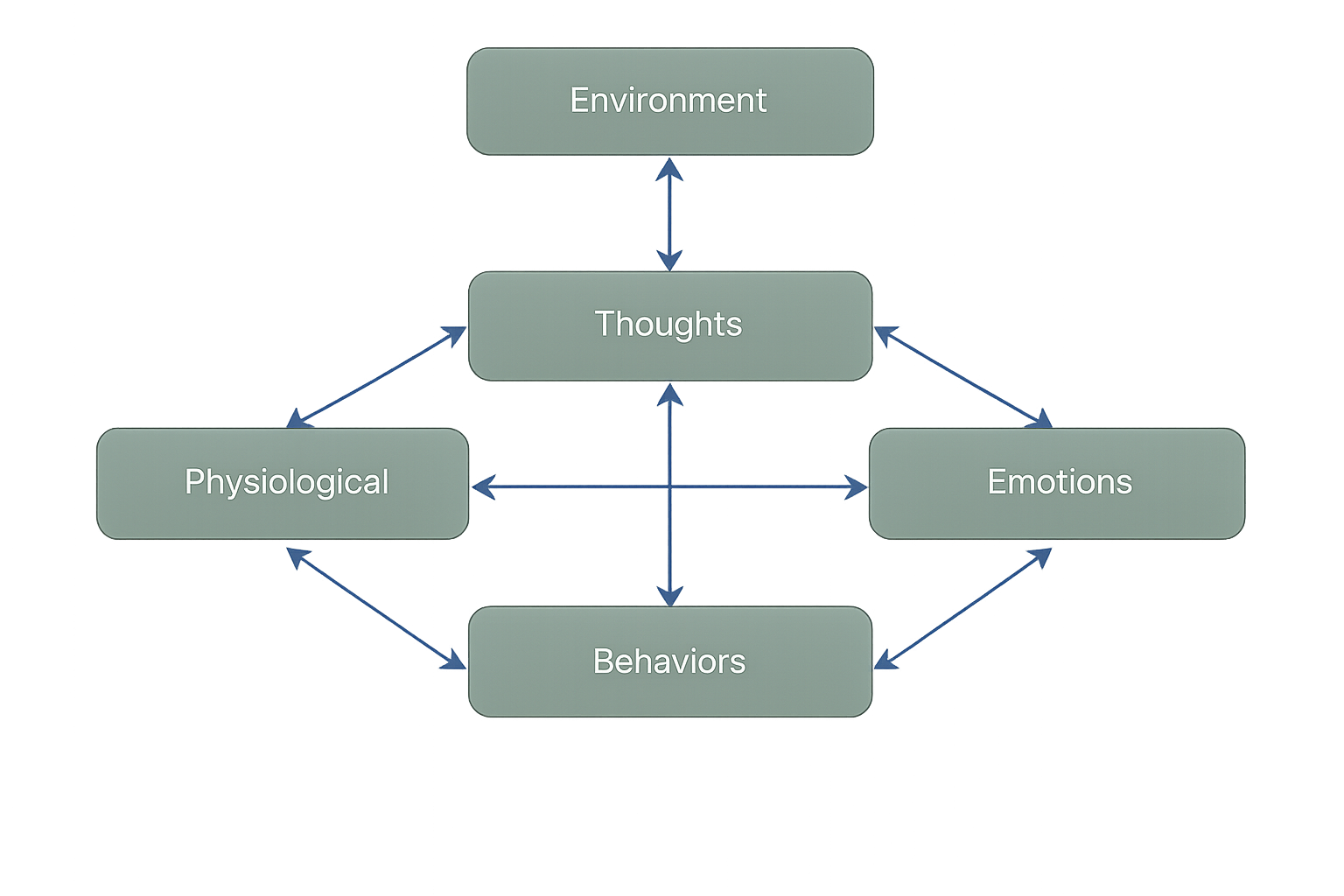
CBT as a Framework, Not a One-Size-Fits-All Treatment
CBT provides a conceptual structure for understanding how certain patterns develop and persist. Within that structure, effective treatment depends on selecting interventions that are specific to the problem being treated.
Different conditions require different applications of CBT principles. As a result, high-quality care involves using specialized, evidence-based approaches rather than applying generic CBT techniques across concerns.
Is CBT Used for OCD?
CBT principles inform the treatment of obsessive-compulsive disorder (OCD), but research consistently shows that Exposure and Response Prevention (ERP) is the first-line, evidence-based treatment for OCD.
ERP is a specialized behavioral application within the CBT framework. It is distinct from general cognitive restructuring or supportive CBT approaches and requires specific training and implementation.
For OCD, research supports Exposure and Response Prevention (ERP) as the first-line, evidence-based treatment. A detailed explanation is available on the Exposure and Response Prevention (ERP) for OCD page.
CBT in Reproductive Mental Health Care
CBT principles may also inform treatment in reproductive mental health, including work related to infertility, pregnancy loss, and perinatal experiences. In these contexts, effective care integrates evidence-based psychological approaches with an understanding of medical, relational, and identity-related stressors.
Treatment in this area is not standardized CBT and often requires adaptations that reflect the complexity and uncertainty inherent in reproductive experiences.
More information about my work in this area is available on the Reproductive Mental Health Services page.
How CBT Fits Into My Practice
In my practice, CBT functions as a foundational framework rather than a standalone treatment offering. Clinical work is guided by evidence-based, condition-specific approaches, including ERP for OCD and specialized care in reproductive mental health.
This structure allows treatment to remain precise, targeted, and aligned with current clinical research.